
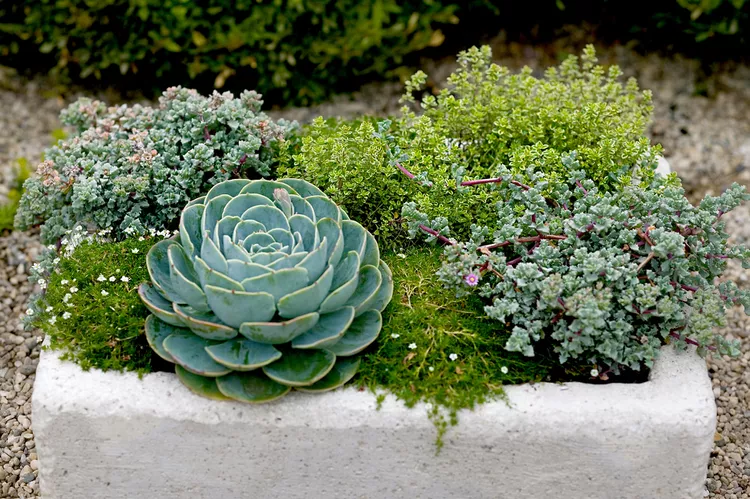
To make a planter that mimics hewn stone, handcraft your own using an artificial stone product called hypertufa. Made of a few simple ingredients, hypertufa planters are lightweight yet durable and make perfect little container gardens. Make several hypertufa pots and group them at different heights. These pots work well for small plants that might otherwise get lost in the garden. You can also make birdbaths, steppingstones, spheres, and other garden accents using hypertufa.
Supplies Required
- Wheelbarrow or large plastic tub
- Rubber gloves
- Face mask
- Portland cement
- Perlite or vermiculite
- Sphagnum peat moss
- Polypropylene fiber (available online or building supply retailers)
- Mold of your choice
- Sheet plastic or plastic garbage bags
- Dowels
- Knife or chisel
- Wire brush
Step 1: Create Mixture
In a wheelbarrow or tub, while wearing rubber gloves and a face mask, mix 2 parts portland cement, 3 parts perlite or vermiculite, 3 parts sphagnum peat moss (sift or break up clumps with your hands), and a handful of polypropylene fiber, which helps strengthen the planter. Mix fibers well so they don't clump. Slowly mix in water, paying close attention to the consistency of the mixture. When the mixture has the consistency of mud, it's ready. If it's crumbly, add a little more water. If it's sloppy, add the dry mix.
Step 2: Form Mixture In Mold
Press mixture into the bottom of your mold to form a 2-inch-thick base. Continue pressing mixture up the sides of the mold, packing it as densely as possible and creating walls with an even thickness of about 1½ inches. Spray mixture with water as needed to keep it moist while you work. We made a disposable foam mold, but if using plastic, metal, or other reusable molds, line it with plastic sheeting to make it easier to remove the planter.
Make drainage holes by pressing a few dowels into the base and all the way through the mixture to the mold.
Step 3: Let Cure
Place the mold on plastic and completely wrap in plastic. Let cure for two to three days. Remove mold from plastic. Remove the dowels then the planter from the mold. A knife or chisel may be needed to loosen the mold. Scrape outer edges as desired using a wire brush. Allow planter to dry and cure for at least four weeks outside but out of direct sunlight. Your cured hypertufa can be left out in freezing temperatures as long as it is off the ground. Once it's cured, you're ready to plant.
Planting a Trough
1. Prepare. Before adding plants to your hypertufa trough, neutralize the portland cement by rinsing the finished trough with ½ cup white vinegar in ½ gallon water. Allow container to dry.
2. Fill. Place a piece of wire mesh over drain holes to allow water to drain without losing soil and to prevent slugs from creeping into the trough. Make a planting mix that holds moisture and drains well by combining equal parts humus, peat or leaf compost, and sand.
3. Plant the trough with an array of sun-loving alpines or slow-growing plants that have similar needs and are adapted to your climate. Cover the soil with ¼ inch of pea gravel to help hold in moisture and give the garden a finished look.
4. Maintenance. Set the raised garden trough on top of a concrete block, bricks, or hypertufa blocks in a protected place where it receives morning or late-day sun. Water the trough garden regularly (every other day in hot weather) throughout the growing season. Do not allow the garden to dry out. Water it with diluted fertilizer once a month. Over time, troughs develop mossy, weathered-looking character.
5. Aging. You can "age" hypertufa (encourage moss growth) by painting the outside of the trough with yogurt. Keep the trough moist and shaded until moss develops.
Plants for a Trough Garden
Select from a huge array of compact, low-growing, and dwarf plants including varieties of:
Hypertufa troughs are a DIY garden project that is worth the effort—they last for years and hold up even in cool temperatures. Create your own hypertufa trough and start planting.