
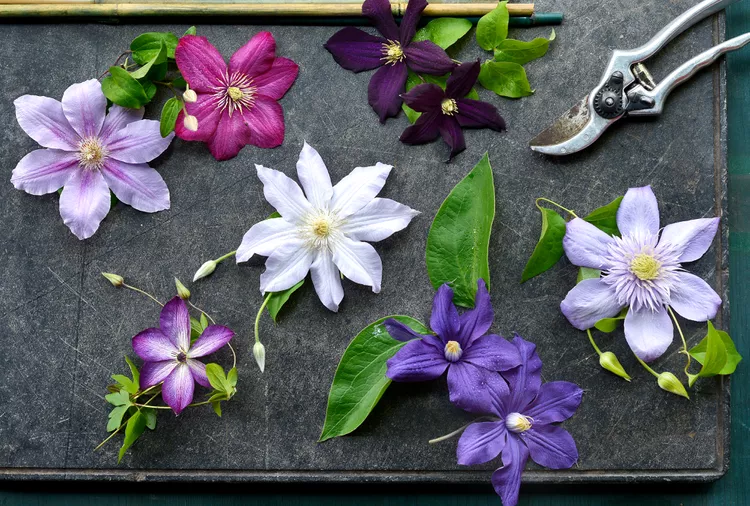
Often growing with little care in the right spot, clematis vines will bloom best when trimmed correctly at least once a year. Knowing how and when to prune clematis can do a lot to keep your vines colorful and healthy, year after year. This guide covers pruning the three main groups of clematis, based on the time of year they bloom.
Clematis Groups
A long-time favorite in American gardens, clematis are perennial, mostly vining plants that are categorized into three groups. Each group grows and blooms somewhat differently, so it’s best to know where your clematis fits before you start trimming your plant.
If you are unsure which group your clematis falls in, go by when it blooms to figure out the best time to prune.
Group 1 (Early Bloomers)
You can expect to do very little pruning in this first group aside from removing broken, dead, or out-of-place vines. Clematis in this first group produce blooms on old vines, so pruning should only be done after their second year, if at all.
Group 1 clematis bloom early in the season, so you can begin trimming, reshaping, cleaning, and deadheading the vines shortly after they bloom, which allows the vines to continue growing throughout the growing season and readies them for the next season.
Group 2 (Early Summer Bloomers)
The clematis in Group 2 include many of the common hybrids readily available in retail stores and online. This group of vines produces flowers on the previous year’s growth and a second flush of flowers on the current year’s growth. They flower twice in a single year under ideal conditions.
Pruning Group 2 clematis is a little more involved than Group 1 because of the repeat blooming, but it keeps plants looking their best. To begin pruning, remove any broken, unruly, or dead vines from the plant in late winter or early spring as buds begin to swell. It is also advisable to remove any dead vines and leaves to minimize the chance of plant diseases and pests in that material.
The first round of pruning living stems can also be done in early spring. Begin by cutting back a third of last year’s growth to about 12 inches from the soil. Leave at least one strongly growing bud on each vine. Group 2 clematis are relatively forgiving, being able to bloom on both new and old stems, so a heavily pruned plant still typically grows well and continues to bloom the following year without issues.
Group 2 clematis can also benefit from a second round of pruning after the first set of blooms has finished to encourage even more growth and a second wave of flowers later in the season.
Group 3 (Midsummer through Fall Bloomers)
The third group of clematis vines produces flowers on new growth in midsummer through early fall. Like Group 2, it includes an extensive collection of hybrids commonly found in retail centers. A popular example is Clematis jackmanii (shown here), which has large purple flowers.
Like Group 1, Group 3 plants are exceptionally easy to prune. Cut back these plants entirely each year to allow for a huge amount of new growth that’ll bring new flowers. In late spring, just as the buds begin to swell, cut all the vines down to about a foot above soil level. Clematis of all kinds grow at a surprisingly fast rate, and Group 3 plants bounce back quickly.
Clematis Care Tips
As with all plants, when living leaves, branches, and stems are removed from the plant, they lose nutrients. To counter this loss of nutrients and boost your clematis in spring as growth resumes, apply a low-nitrogen fertilizer followed by a balanced fertilizer every four weeks throughout the growing season. Clematis are heavy feeders and appreciate the extra supply of nutrients that allows them to bloom to the best of their ability.
Each spring, mulch around the base of the clematis. Mulch helps hold moisture in the soil and keeps the ground cool. Apply a 3- or 4-inch layer of composted bark chips, shredded bark, or another organic mulch, and remove any weeds that might compete with the clematis roots.